
Tulane Innovation Institute Spring 2026 Provost's Proof of Concept Fund Awards $150,000 to Three Faculty Researchers in Diagnostics, Surgical Infection Prevention, and Quantum Materials

The Spring 2026 Provost Proof of Concept recipients were honored at the Spring 2026 Open Medical Innovation Challenge (Open MIC Night).
Promising university research often stalls at the border between discovery and application. The Tulane University Innovation Institute, in partnership with the Office of the Provost, established the Provost's Proof of Concept Fund (PPOC) in fall 2022 to cross that border — providing grants of up to $50,000 to support the technical development and market research needed to bring innovations to commercial viability, whether through licensing to existing companies or launch as spinout ventures.
The program, administered by the Robert L. Priddy Lab, reflects a growing interest across the university for translational work. Now in its seventh awards cycle, PPOC received 21 applications this spring, representing seven schools — the broadest cross-disciplinary pool in the program's history — collectively requesting more than $1 million in support. Since launch, 128 applications have sought more than $6 million in cumulative funding. Three $50,000 awards announced on April 15, 2026, bring the program's total investment to more than $1.15 million.
“To date, six spinouts have emerged from this early-stage funding program, which reflects the quality of Tulane research and a meaningful shift in how our faculty view the potential of their work. Our goal is to make the path from lab to market more accessible for all Tulane researchers,” said Kimberly Gramm, PhD, MBA, David and Marion Mussafer Chief Innovation and Entrepreneurship Officer of the Tulane Innovation Institute.
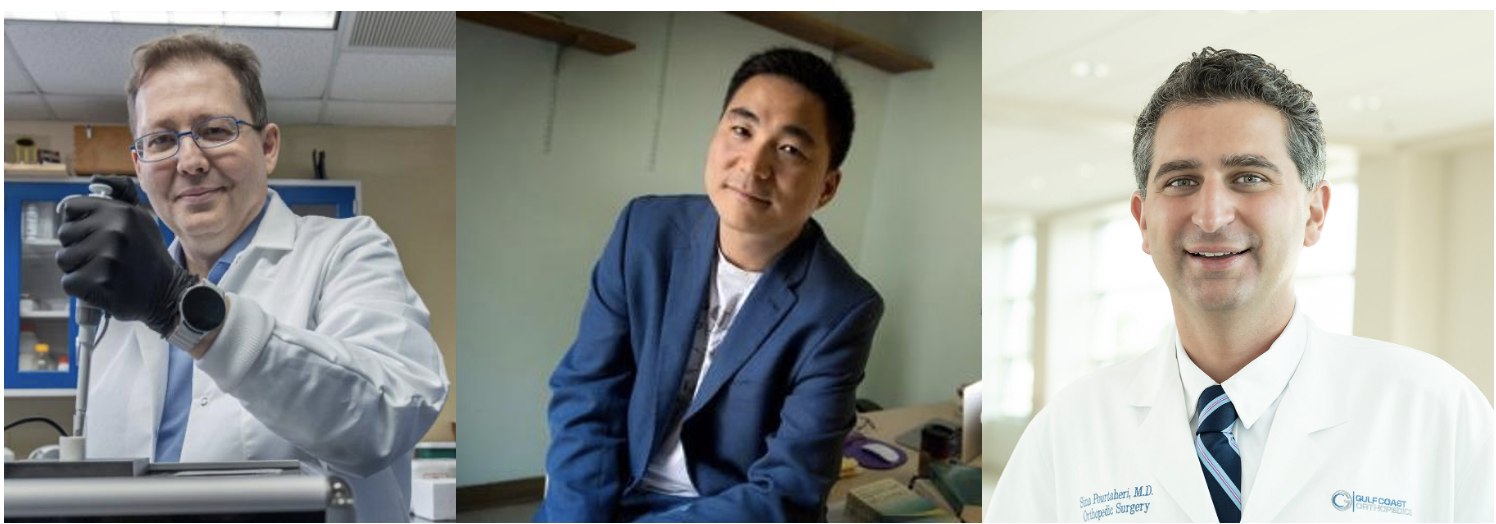
Pictured left to right: Damir Khismatullin, Sina Pourtaheri, and Jianwei Sun
The spring 2026 honorees are:
A Contact-Free Levitated Droplet ELISA Platform for Bioanalytical Applications
Standard laboratory tests for detecting biological molecules—proteins, antibodies, and other biomarkers—typically rely on reactions that occur on solid surfaces, with samples moved manually from step to step. This process is slow, prone to contamination, and often requires more biological material than many applications can afford.
Damir Khismatullin, PhD, Associate Professor of Biomedical Engineering, in the School of Science and Engineering, is developing a platform that eliminates the need for a surface altogether. His team uses acoustic radiation forces—precisely controlled sound waves—to inject, mix, and suspend tiny droplets of sample and reagent in midair, where detection occurs without physical contact. This approach reduces the sample volume required, improves accuracy, and opens new possibilities for what standard lab tests can measure.
With Provost Proof of Concept funding, Khismatullin’s project will build and test a working prototype of this levitated droplet platform, validating its performance across key bioanalytical measurements. He will also conduct customer discovery interviews to confirm market need and refine the path to commercialization.
Khismatullin brings direct entrepreneurial experience to the effort as co-founder, President, and Chief Science Officer of Levisonics, a medical device startup developing novel platforms for blood coagulation analysis and fluid measurement, making this project a natural extension of technology already advancing toward clinical and commercial application.
Sustained-Release Vancomycin Nanospheres to Prevent Infections After Surgery
In operating rooms, routine spine surgeries carry postoperative risks. Surgical sites can harbor difficult-to-control bacterial infections, in part because standard antibiotics—delivered through the bloodstream—often fail to maintain effective concentrations where they are needed most.
Sina Pourtaheri, MD, is a spine surgeon at Gulf Coast Orthopedics and an Adjunct Associate Professor in the Department of Chemical & Biomolecular Engineering in the School of Science and Engineering. At Tulane, he and his team are pursuing a novel, patented approach that replaces conventional systemic antibiotic delivery with sustained, localized treatment at the surgical site. Their work advances a hydrophobic ion-paired (HIP) vancomycin nanosphere platform, engineered to package the antibiotic into microscopic spheres that remain at the surgical site and release the drug gradually over time. The aim is to maintain a consistent therapeutic level where it is needed while limiting exposure to the rest of the body.
“This award will enable us to do what conventional research grants cannot,” Pourtaheri said, noting the ability to integrate customer discovery, health-economic validation, and industry-aligned product development into their existing scientific foundation. The team plans to define a clear regulatory and partnership pathway while building a prototype tailored to operating-room workflows, with the goal of a scalable, commercially credible product. The need is pressing, he added: “Surgical site infections account for roughly one in five healthcare-associated infections, and in spine surgery—where nearly 900,000 procedures are performed annually in the United States—infection rates can reach as high as 16% in higher risk patients, such as those with myelodysplasia.”
Accelerating Quantum Materials Design: A Scalable Tool for Predicting Electron–Phonon Interactions
The performance of advanced materials — from superconductors to next-generation semiconductors — often comes down to a subtle but critical interaction: the way electrons and atomic vibrations influence each other. Known as electron–phonon coupling (EPC), this interaction underpins key properties such as superconductivity, thermal conductivity, and charge transport, making it central to the design of materials for quantum computing, energy storage, and microelectronics. Yet accurate prediction of EPC has long been a challenge in computational materials science.
Jianwei Sun, PhD, a professor at Tulane's School of Science and Engineering, and his team have demonstrated that the advanced r²SCAN density functional delivers transferable, accurate, and efficient EPC predictions across a wide array of materials — including transition metal oxides, thermoelectrics, 2D materials, and superconductors — making it well-suited for the high-throughput industrial screening that modern materials discovery demands. The Provost Proof-of-Concept funding will help the project benchmark the method across a targeted set of quantum and energy materials, integrate results into user-ready software, and conduct structured outreach with industry and national laboratory partners — laying the groundwork for commercialization through licensing or subscription-based services.
A portion of the $50,000 budget will also support a senior graduate student who will lead the core technical work, with additional funds allocated for conference travel, where the team will engage directly with potential partners and present their findings.
The spring 2026 PPOC honorees represent different disciplines, serve different markets, and face different technical challenges. What unites them is a faculty investigator and their team who have chosen to go beyond publishing findings to test how their research can create change in the world. The application for the next cycle opens May 1, 2026, and the program is available to Tulane faculty, staff, and trainees.
