
Joe Wagner Helps Tulane Researchers Advance Proof-of-Concept Projects With AI
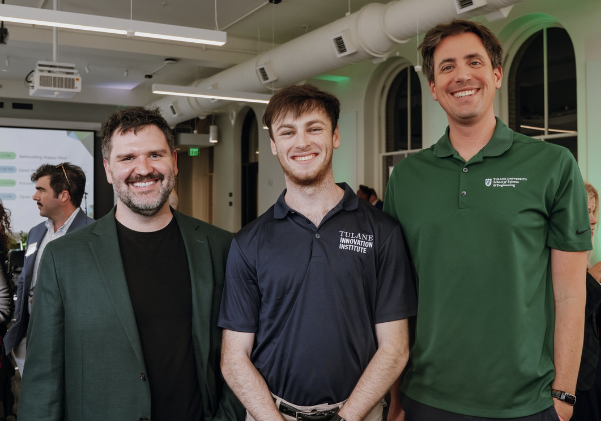
Joe Wagner (center), pictured with Claiy Christian (right) and Nicholas Mattei, associate professor of computer science and co-director of the Tulane Center for Community Engaged AI.
Joe Wagner joined the Tulane Innovation Institute in March 2026 as its inaugural AI Fellow, supporting Tulane innovators and faculty members, with a particular focus on Provost’s Proof of Concept Fund (PPOC) grantees. Joe works directly with researchers to scope, prototype and deploy AI-driven solutions that help advance their research toward real-world applications.
“We are thrilled that Joe is here as a resource for our PPOC winners,” said Claiborne Christian, executive director of commercialization, who oversees PPOC projects in the Robert L. Priddy Lab. “We, along with our partners in the Center for Community Engaged AI, saw a need for technical support for our researchers and innovators, which led directly to the creation of two fellowship positions at the Innovation Institute and in the School of Science and Engineering.”
A New Orleans native, Joe earned both his undergraduate and master’s degrees from Tulane University and graduated in May 2025. He studied physics and computer science before specializing in artificial intelligence and machine learning. His background includes research in reinforcement learning in real-world environments, with a focus on developing ethical and responsible AI systems.
Since joining the Institute, Joe has worked with researchers across disciplines to help turn early-stage ideas into prototypes and testable technologies.
In the School of Science and Engineering, he has supported Damir Khismatullin and Georgy Sankin, Spring 2026 PPOC awardees, as they develop a new approach to ELISA, a common laboratory test used to measure proteins and other biomolecules in blood. Instead of mixing samples on a traditional plastic plate, their platform uses sound waves to suspend and control tiny droplets in midair. The approach could reduce contamination and material waste while enabling tests with much smaller blood samples.
Joe is helping make the system more stable and automated by developing AI-powered imaging tools that monitor each droplet’s shape and position. He is also developing controls that can adjust the system and stop a test if a droplet becomes unstable. This work is helping the team run longer experiments, collect more reliable data and move the technology closer to a working prototype.
Joe is also working with Jianwei Sun, who was recently selected to lead a team through the U.S. Department of Energy’s Genesis Mission to develop an AI-driven approach for discovering next-generation superconductors and quantum materials.
As part of Jianwei’s Spring 2026 PPOC award and in collaboration with the Center for Community Engaged AI, Joe is applying artificial intelligence to a complex problem in quantum chemistry. The team has developed physics-informed neural networks to study the exchange-correlation hole, which helps scientists model how electrons interact within atoms and molecules.
“My role was to build known physical rules directly into the models, develop the pipeline used to test them, and quickly compare different approaches,” Joe said. “This allowed the research team to explore ideas more efficiently while ensuring the models remained grounded in physics.”
In the School of Social Work, Joe has collaborated with Margaret Downey, a Spring 2025 PPOC awardee, to explore how technology can better support people as they make decisions about contraception, pregnancy and fertility.
The prototype application combines journey tracking, visual decision-making tools, and reliable medical and legal information in one place. Joe is currently building an early chatbot within the application that can answer reproductive health questions in a thoughtful, patient-centered way.
Joe’s work is one example of how PPOC provides researchers with more than a $50,000 grant. The funding supports the work needed to move a discovery toward commercialization, including prototyping, customer discovery, market research, intellectual property analysis and staffing. Awardees can also access additional resources and expertise through the Innovation Institute.
That can include mentorship through the Green Wave Innovation Network, opportunities to participate in pitch competitions such as Open Medical Innovation Challenge (MIC) Night and $50K Demo Day, and educational programming focused on intellectual property and the process of creating a spinout. As a technology progresses, researchers can also receive support in pursuing SBIR/STTR funding or exploring investment through Tulane Ventures.
Together, these resources give researchers support at each stage of moving a discovery beyond the lab.
“My favorite part of working at the Tulane Innovation Institute is the opportunity to collaborate with people who approach problems from different perspectives,” Joe said. “I get to work with researchers, engineers, product teams, and experts across a range of industries, so I’m always learning something new. That variety keeps the work interesting, and I really enjoy being part of a team where everyone works together to develop new technologies.”
Since the PPOC Fund launched in March 2023, 23 awards totaling $1.16 million have supported Tulane researchers. Applications for the Fall 2026 PPOC cycle are open through September 4, 2026, at innovation.tulane.edu/provosts-proof-of-concept-fund.