
Julie Albert Develops Eco-Friendly Coating for Coastal Restoration Materials

Julie Albert pictured with her family at the Provost’s Proof of Concept Awards in fall 2025.
The materials used to protect newly planted marsh grasses often cause as much environmental harm as they prevent. This is one of the societal challenges that the Provost's Proof of Concept Fund is now supporting a solution for at Tulane University.
Julie Albert, an associate professor in the Chemical and Biomolecular Engineering Department at Tulane's School of Science and Engineering, is using the funding she received in fall 2025 to develop a biodegradable coating for natural-fiber products such as burlap to address coastal restoration issues. Most restoration materials on the market today, such as geotextiles, silt fences, turf reinforcement mats, and sapling protectors, are made from traditional plastics, the same plastics blamed for microplastic pollution. Natural fibers are a viable replacement, but they also degrade too fast to survive a restoration project.
Albert’s lab is developing and testing coatings made from polyhydroxyalkanoate, or PHA, a bioplastic produced through microbial fermentation that marine microbes break down naturally rather than leaving microplastics behind. Using dip-coating and melt-pressing methods, the team applied PHA-based polymers to burlap, then submerged the fabric in seawater for roughly nine months to see how much mass it retained as the polymer degraded and its crystallinity increased. Her team then used this information to design a material durable enough to protect saplings and clean enough to disappear without polluting the marsh grass and marine ecosystem. This project is also in collaboration with Nereid Biomaterials and Glass Half Full, the nationally recognized New Orleans business that recycles glass into sand for coastal restoration founded by Tulane alumni Franziska Trautmann and Max Steitz.
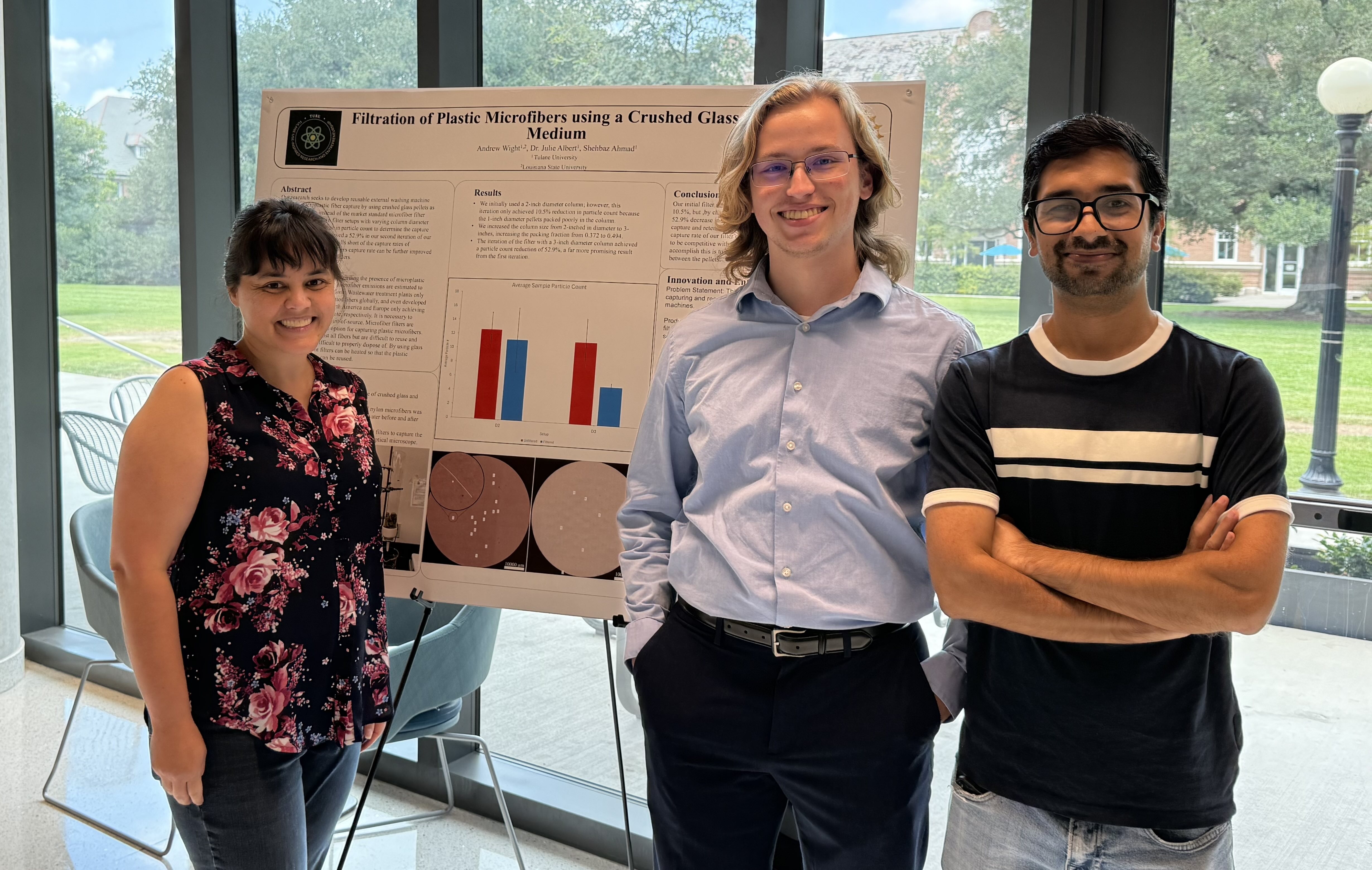
Julie Albert pictured with undergraduate student Andrew Wright and PhD candidate Shehbaz Ahmed, as part of the Tulane Use-Inspired Research and Entrepreneurship Program (TURE) this summer.
Albert and the Glass Half Full team co-founded ReCoast, initially a Tulane-based research team and now a division of Glass Half Full, focusing on economic strategy, environmental protection, and community engagement, and it was initially funded through the National Science Foundation's Convergence Accelerator Program, which aimed to create a smart, integrated, connected, and open ecosystem for the blue economy.
From researching glass recycling to developing better ways to shield newly planted marsh grasses, Albert and the Glass Half Full team remain focused on solutions that protect coastlines and wetlands.
"Louisiana's coastline is disappearing faster than most people realize, so doing what I can to protect it for my child, his peers, and future generations to come is important to me, " said Albert. "The Provost's Proof of Concept Fund has let us bring undergraduate and graduate researchers into this work, giving them hands-on experience in finding solutions to the environmental challenges that are defining their generation, while also helping us translate the research into something coastal restoration practitioners can use.”
Through the Provost’s Proof of Concept $50,000 grant, Albert and her lab were able to support a graduate student and several undergraduate students to conduct the work, purchase materials, create prototypes, and perform customer discovery on other organizations and facilities that may find the team's help to scale up the coating process and eventually use their product.
The team's early findings on PHA-coated burlap were published in March 2026 in the ACS Applied Engineering Materials Journal, Investigating the Durability of PHA-Coated Burlap for Coastal Restoration.
"The Provost's Proof of Concept Fund was designed to commercialize the exciting research taking place at Tulane University to solve society's greatest problems, which for Louisiana includes addressing climate challenges like coastal restoration," said Claiborne Christian, executive director of commercialization at the Tulane Innovation Institute. "We are proud to support Julie's work. Her research interests in engineering nano- and micro-structured polymeric materials for applications in the environmental sectors are exactly the kind of expertise this fund exists to help bring research to market."
Albert's project is one of 23 PPOC awards issued since the fund launched in March 2023, representing $1.16 million in funding to Tulane researchers. That investment has helped launch seven spinout companies and supported 55 students, and 12 of those teams have gone on to raise an additional $9 million.
Applications for the fall 2026 cycle are open through Sept. 4, 2026 at innovation.tulane.edu/provosts-proof-concept-fund.