
How Tulane Historian Alexis Culotta Is Rethinking Art History Through Digital Networks
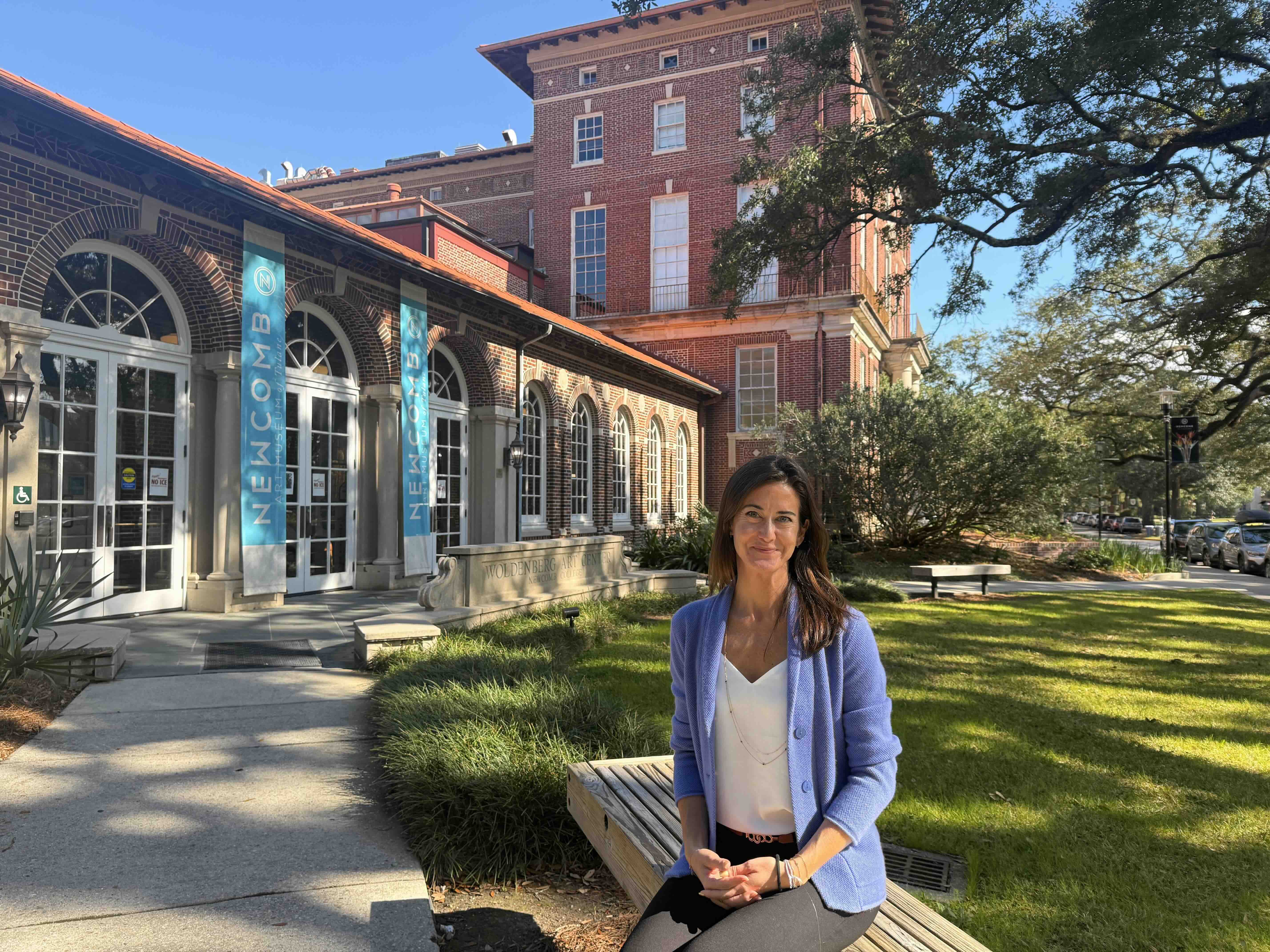
Alexis Culotta at the Woldenberg Art Center, Tulane University
If Raphael had a Snapchat map in Rome during the High Renaissance, who would appear on it? His teacher, Pietro Perugino? The architect Donato Bramante, who helped secure his papal commission? One of his patrons, Agostino Chigi? His rival, Michelangelo? And how many more dots—craftspeople, women, assistants—would we see but fail to recognize, their contributions not recorded in art history books or mentioned in museums.
In today’s zeitgeist, people increasingly try to understand relationships through networks: mutual connections on LinkedIn, influencers followed on Instagram. In New Orleans, a common icebreaker is, “Where did you go to high school?” At Tulane, it might be, “What department are you in?” Social and professional networks help us find context.
At Tulane's School of Liberal Arts, Alexis Culotta is applying that same perspective to art history. Culotta, a senior professor of practice in art history, has partnered with her husband, Aron Culotta, professor of computer science at the School of Science and Engineering and director of the Center for Community Engaged AI, to develop a new way of seeing artistic collaboration. Together, they created the Artistic Network Toolkit (ANT), an open-source visualization platform that transforms creative relationships into interactive maps, revealing the hidden collaborators behind canonical subjects.
The idea grew from Culotta’s graduate research. While writing her dissertation and first book, she recognized a pattern: artists celebrated as solitary geniuses rarely worked alone. They trained apprentices, shared ideas with peers, relied on benefactors, and engaged in social and economic systems that shaped their work. Many contributors—often marginalized or unnamed—played essential roles in artistic innovation but disappeared from history books. For instance, Polidoro da Caravaggio, who helped Raphael with numerous projects, is seldom discussed alongside the master himself. Culotta set out to make those collaborations visible.
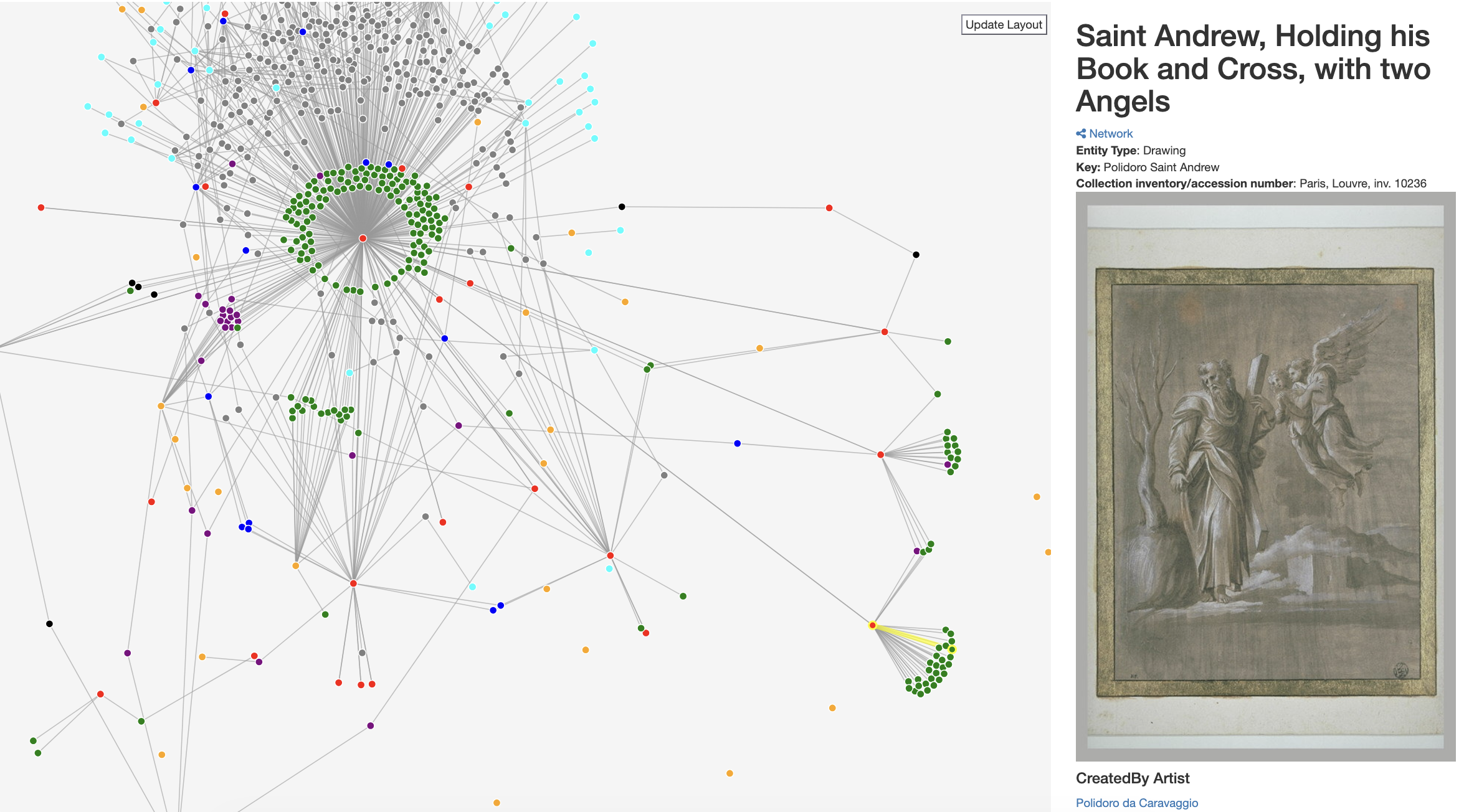
Screenshot of Artistic Network Toolkit (ANT)
That mission led to a 2024 National Endowment for the Humanities grant to support ANT’s development, followed by a 2025 Innovative Research Award at Tulane’s Research, Scholarship, and Artistic Achievement Awards.
ANT is designed for accessibility. Users enter information such as artists, artwork photos, dates, and commissions into a spreadsheet, and with a click, it becomes an interactive, searchable website that displays collaborators and influencers. No coding required.
The team’s first case study focused on Raphael. Mapping his Roman circle revealed the artists who influenced him, the assistants in his workshop, and the generations who carried his ideas forward—reframing art history as a web of collaboration rather than a sequence of isolated achievements. They also tested the platform on colonial Latin American painters and Chinese ceramics.
While ANT remains open source and customizable for researchers, it also holds promise for partnerships with museums and auction houses. Institutions could use the tool to visualize their collections, map provenance, and deepen public engagement and education.
Within the School of Liberal Arts, Culotta has become a leading voice in digital humanities, blending traditional scholarship with computational tools. Her new course that launched this semester, Art of the Digital Humanities, introduces undergraduates to the intersection of data and art history through case studies, workshops, and collaborative projects that encourage creative thinking. Students learn to design and conduct original research using digital methods.
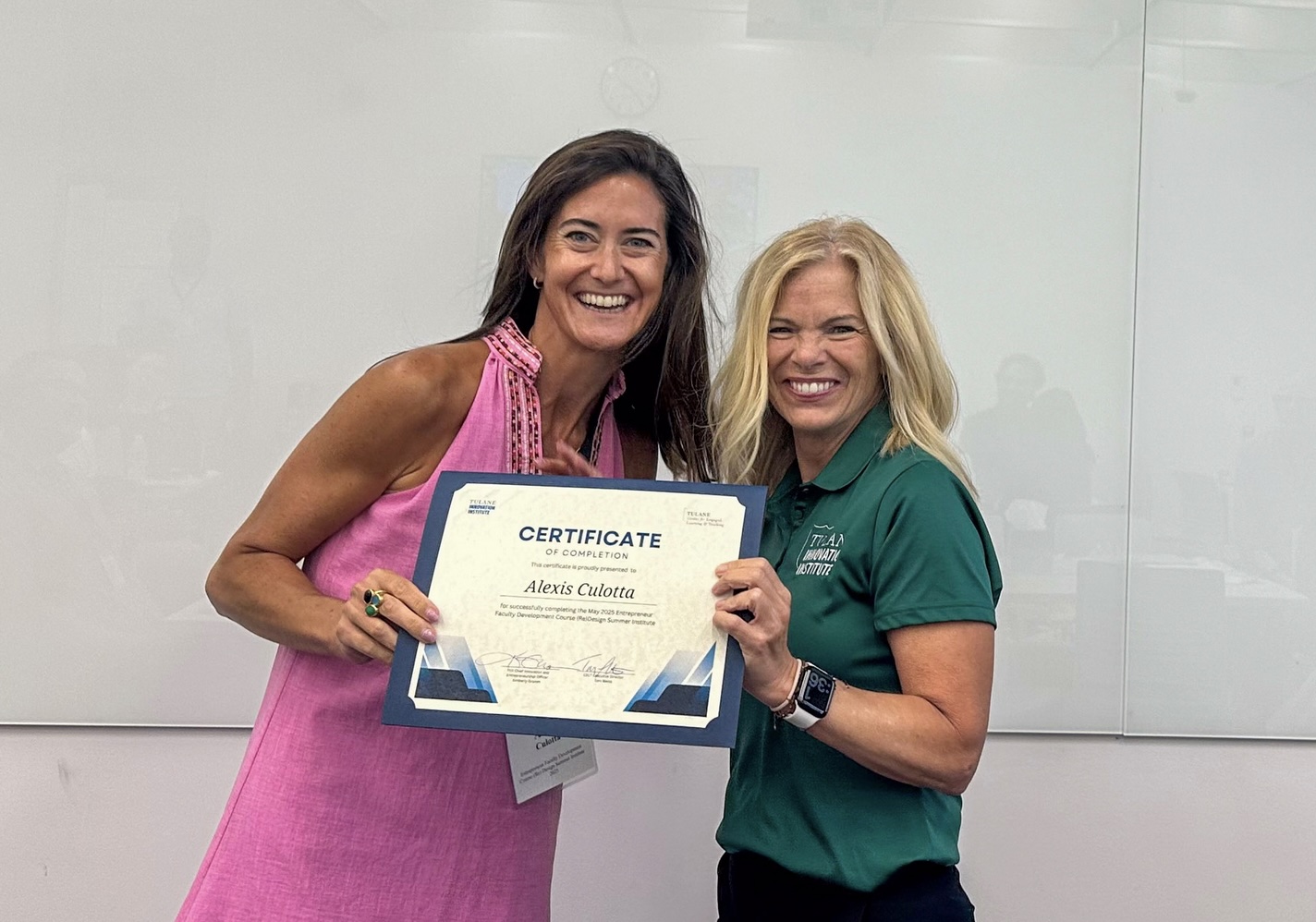
Alexis Culotta and Kimberly Gramm, David and Marion Mussafer, chief innovation and entrepreneurship officer at the Tulane Innovation Institute, at the Faculty Innovation Workshop graduation ceremony.
Culotta’s interest in novel teaching approaches grew during the Faculty Innovation Workshop, hosted by the Tulane Innovation Institute and CELT in May 2025. She initially aimed to reimagine her Museum Internship course, but the workshop inspired her to incorporate entrepreneurial strategies across multiple classes. Her students now assess their creative mindset at the start and end of a course, practice interview techniques, and explore how inventive thinking shapes both art and professional life.
“Artistic practice is very entrepreneurial,” Culotta said. “Artists identify opportunities, build networks, secure patronage, and adapt to changing markets. Teaching students to recognize those patterns helps them think strategically about their own creative work and career paths.”
For Culotta, ANT, together with lessons from the Faculty Innovation Workshop, serves as a teaching tool for her students. By integrating digital humanities, applied research, and an entrepreneurial mindset, she shows Tulane students that collaboration has shaped art and innovation throughout history and will continue to connect ideas, people, and practices in the future.
