
Ibrahim Demir Brings AI to Tulane for Environmental Monitoring, Medical Research, and Academic Innovation
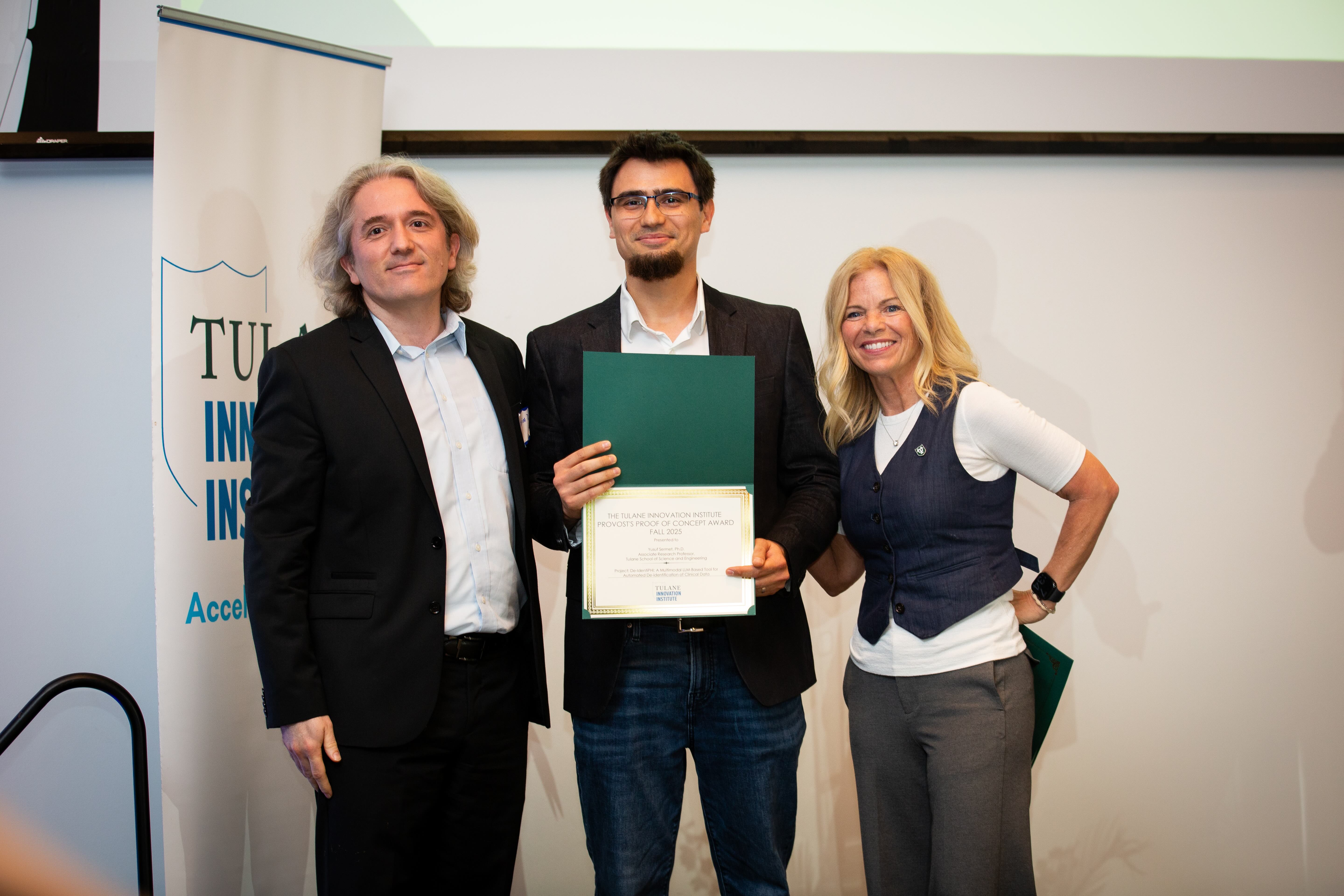
Ibrahim Demir, pictured with Yusuf Sermet, receiving a Fall 2025 Provost's Proof of Concept Award from Kimberly Gramm, the David and Marion Mussafer Chief Innovation and Entrepreneurship Officer at the Tulane Innovation Institute.
When Ibrahim Demir speaks, his enthusiasm for artificial intelligence seems to move at the same velocity as the technology itself—expansive and relentlessly forward-looking. He talks about AI as a practical tool, something to deploy now to solve problems, reduce friction and improve daily life. His ambitions extend from Tulane University and the state of Louisiana to environmental systems with national and global significance.
Demir's role at Tulane officially started in January 2025 when he transferred from the University of Iowa. He is currently managing a team of 35 researchers—seven of whom transferred from Iowa to Tulane. In his first year, his team published 35 peer-reviewed journal articles, and submitted 35 grant proposals. In the last 2 months alone, the team submitted 13 collaborative proposals with over $30M multi-institutional budget. The pace is notable not only for its volume but also for its quality and consistency, indicating a research operation already aligned with momentum.
His earlier work at the University of Iowa lays out a foundation for what he aims to achieve at Tulane. While based along the Upper Mississippi River, Demir developed flood-risk detection and response systems that were licensed by states including Florida, Texas, South Dakota, and Missouri. Now situated at the river's southern mouth, in a region familiar with flood disasters and urgently in need of coastal restoration, his research gains new possibilities.
"Everything the river carries—its problems as well as its opportunities—ultimately converges here," Demir said. "AI tools can help us interpret increasingly erratic weather patterns and manage environmental unpredictability in ways we couldn't before."
Building on a distinguished career in climate and data science, Demir — who leads the Tulane HydroInformatics Lab — was named the Michael A. Fitts Presidential Chair in Environmental Informatics and Artificial Intelligence. He serves on the faculty of the Department of River-Coastal Science and Engineering and is a core member of Tulane's ByWater Institute, positions that support his efforts to integrate AI across the university and beyond.
That practical orientation shapes his vision for Tulane. He is intent on making the university a model for integrating AI into academic life in ways that are responsible and useful. "We're creating programs that streamline administrative and teaching tasks—merging existing platforms, simplifying grading and reducing the labor that accumulates around faculty work," Demir explained. "In time, I imagine these tools becoming exportable, licensed to other universities."
"Professor Demir's arrival is a major boost for Tulane's efforts to translate research into commercial impact," said Clay Christian, executive director of commercialization at the Tulane Innovation Institute. "His experience in AI and in designing applications for university, municipal, and private institutions is a tremendous asset for supporting aspiring Tulane spinouts and creating licensing opportunities that allow researchers to advance their own projects. He is moving AI out of the headlines and into our lives at Tulane and in New Orleans."
Demir is already putting this vision into practice. In collaboration with Yusuf Sermet, associate research professor in the School of Science and Engineering and the Department of Pediatrics, he is developing De-IdentiPHI, an AI platform that automates the de-identification of complex clinical data—a step that often slows medical research due to HIPAA requirements. The project received $50,000 from Tulane's Provost Proof of Concept Fund last fall to develop a validated prototype.
For Demir, teaching is inseparable from this systems-level thinking. He plans to launch a new course on AI for civil and environmental engineers, embedding AI literacy into professional training. At the same time, he emphasizes that technical fluency does not mean blind reliance.
"I give the same advice to students that I offer my own high school-aged children," Demir said. "Follow the literature and news on AI, continue learning to code, and understand how machine learning works. Calculators can multiply instantly, but children still need to learn multiplication to understand what the machine is doing for them."
Underlying all of this is a commitment to improving human capacity. "Our lab wants to support our colleagues, strengthen the safety of local communities and ensure technological advances translate into public benefit."
Water shapes cities, economies, and ecosystems, but it requires careful monitoring, modeling, and guidance. AI calls for a similar approach. In a world shaped by fast-moving currents and constant adaptation, Demir’s work demonstrates how AI can serve the public good. His innovative ideas have the potential to generate spinouts and licensed applications, turning Tulane’s research into tools that improve communities everywhere.
