
How a Tulane Venture Capital Course Launched Nicole Davis into New Orleans' VC Ecosystem
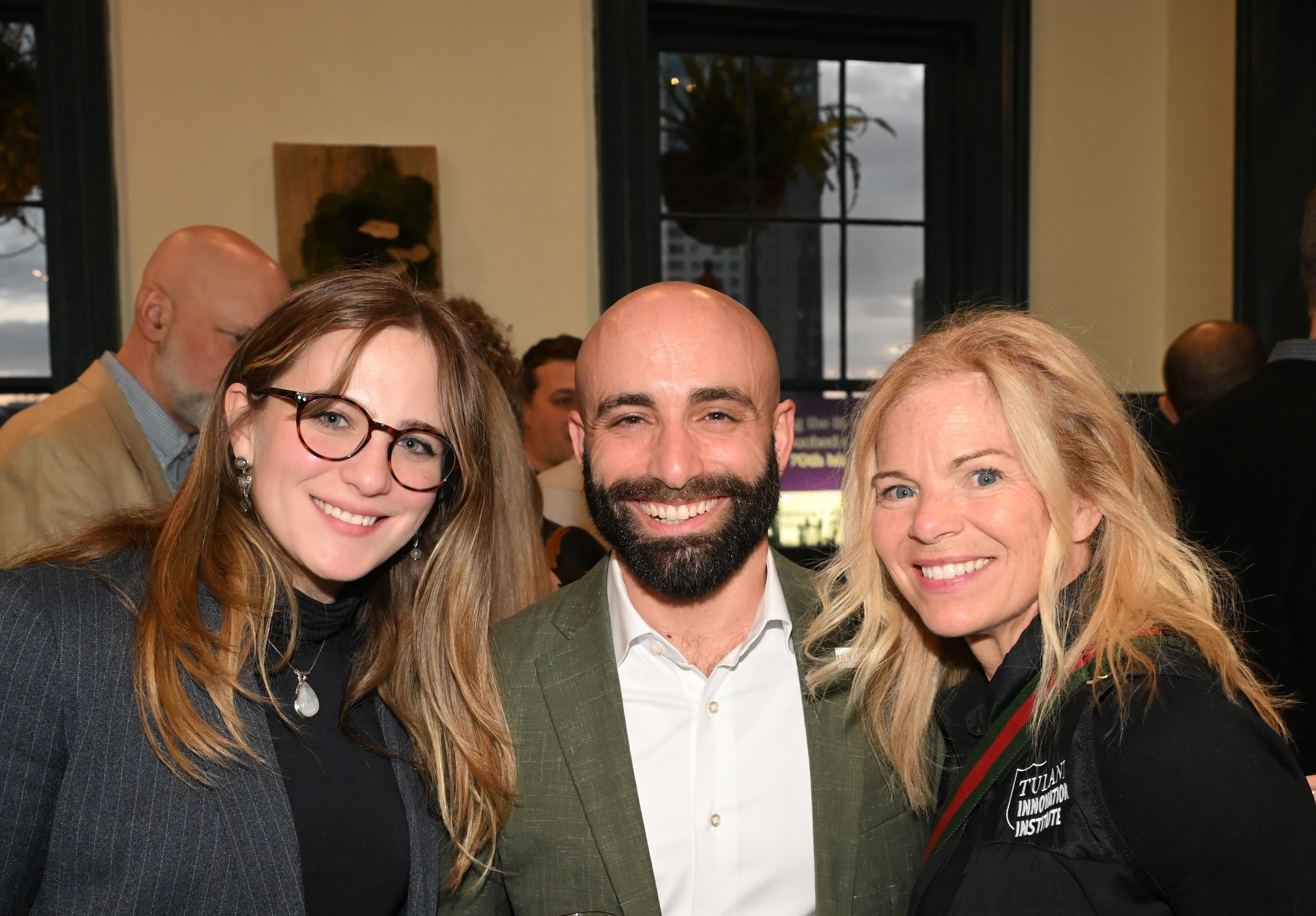
Nicole Davis with Evan Nicoll, 1834 Ventures, and Kimberly Gramm, Tulane Ventures
Nicole Davis graduated in 2025 from Tulane University with degrees in finance and computer science, where she discovered her interest in venture capital through Tulane’s inaugural venture capital course, facilitated by Professor David Thompson in the A.B. Freeman School of Business, the Tulane Innovation Institute, and Tulane Ventures.
Tulane Venture Capital and Angel Investing (FINE 4410) introduced her to a structured approach to early-stage investing that blends financial analysis with insights into how companies are built and scaled. That experience helped shape her trajectory from a broad interest in finance and technology into a career in venture capital.
Today, Nicole is an analyst at 1834 Ventures, where she evaluates startups from pre-seed to Series A across industries and develops automation tools to streamline deal flow and fund operations. Her work builds directly on the analytical framework introduced in the classroom, assessing business models, evaluating teams and markets, and testing the assumptions behind financial narratives.
Prior to her full-time role, she supported both 1834 Ventures and Tulane Ventures, contributing to startup evaluation and early-stage investment processes. She also gained experience at multiple internships, including Gulf South Angels, where she supported due diligence and deal flow analysis; My Next Electric, where she helped develop the “Batteries Included Thesis” through market research in the electric-vehicle and battery sectors; and Hunt Oil Company, where she completed an asset management and forecasting internship and contributed to efforts integrating generative AI into financial applications. We sat down with Nicole to talk about her experience taking FINE 4410: Venture Capital and Angel Investing.
Interview with Nicole Davis
Why did you decide to take the inaugural venture course at Tulane?
I decided to take the venture course because I believe that one of the best ways to make a positive impact on local communities and the world is through early-stage investing. Professor Thompson’s course was my first experience of what that looks like in practice, and this was the best decision I made for my academic and professional life. I have long been interested in learning what makes businesses tick and grow from inception to fundraising and beyond. I learned that experiential learning was the key to deepening my understanding and efficacy. Professor Thompson’s teaching style is engaging, sometimes unpredictable, and effective in getting a point across. His confidence and presence radiate throughout the classroom.
What are the highlights of the course, and what are the most valuable lessons learned?
Professor Thompson and the Tulane Innovation Institute, in partnership with Tulane Ventures, created a course that allows students to contribute to the community, build fundamental and advanced skills in company analysis, and learn to think critically. Trust and confidence are built in the classroom. Professor Thompson and Marco Melero, Tulane Ventures analyst, curated a unique curriculum that places students at the intersection of analysts and business owners.
At first, I struggled with content, so I spoke with Professor Thompson. Thompson taught me the importance of being a “dog with a bone,” and that grit, confidence, and passion for what you do are key indicators of success. This lesson was repeated throughout the course. My team was assigned to analyze a complex medtech company, which was intimidating. It would have been easy to get lost in the details had we not had the guidance from Professor Thompson and Marco. By the end of the course, drawing strong conclusions and performing technical analysis had become second nature, thanks to their teaching and endorsement of our abilities.

Nicole Davis at a Tulane Innovation Institute ecosystem networking event
How did the course impact your career post-graduation?
Following this course, I decided to pursue a career in venture capital in New Orleans. I have been working as an analyst at 1834 Ventures, where I analyze deal flow and invest in ideas and people emerging from Tulane and the community. This opportunity would not have existed without the support of Professor Thompson, Marco, and the Innovation Institute’s Chief Innovation and Entrepreneurship Officer, and Managing Director of Tulane Ventures, Dr. Kimberly Gramm.
Dr. Gramm saw the impact of the venture course after watching my team’s final presentation and saw my potential. She hired me as an intern at the Innovation Institute, where I built on the foundation laid by the class.
In the class, we spoke frequently about asymmetric information, having an edge from knowing something others don’t. Professor Thompson explained it as seeing potential in the overlooked and knowing that the gap in perception is where opportunity lives. I see tremendous talent and value in New Orleans, a city that flows under the radar as an entrepreneurial hub and is often underestimated.
By creating this course, Dr. Gramm and Professor Thompson are addressing asymmetric information and helping to strengthen the region’s broader venture ecosystem. Dr. Gramm once said, "What we are building here in New Orleans through Tulane’s programming is different in that even though we don’t have the venture investment in this community today, we want to provide support and resources, so the companies become investable, and never leave our ecosystem." That is not the mindset of every investor, and it is a competitive edge for the community.
Tulane is investing in the community and cultivating talent in the classroom. Having been in the pilot course, I can attest to the growing impact of the course and the Institute on students, the community, and portfolio companies addressing global issues.